Old Mexican Actor Who Dances Funny
| Cantinflas | |
|---|---|
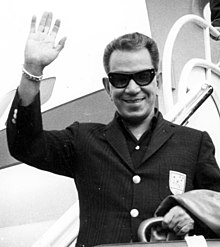 Cantinflas in 1964 | |
| Built-in | Mario Fortino Alfonso Moreno Reyes (1911-08-12)12 August 1911 Santa María la Redonda, Mexico City, Mexico |
| Died | twenty April 1993(1993-04-20) (aged 81) Mexico City, Mexico |
| Burial place | Panteón Español, Mexico City, Mexico |
| Nationality | Mexican |
| Other names | Mario Moreno |
| Citizenship | Mexican |
| Instruction | Instituto Politecnico Nacional Chapingo Autonomous Academy (Agronomy, few months) |
| Occupation | Comedian, thespian, screenwriter, film producer, vocalizer |
| Years active | 1936–1984 |
| Party | Institutional Revolutionary Party |
| Spouse(southward) | Valentina Ivanova Zubareff (m. 1936; died 1966) |
| Children | Mario Arturo Moreno |
Mario Fortino Alfonso Moreno Reyes (12 Baronial 1911 – 20 April 1993), known by the stage name Cantinflas (Spanish pronunciation: [kanˈtiɱflas]), was a Mexican comedian, actor, and filmmaker. He is considered to accept been the most widely-accomplished Mexican comedian and is celebrated throughout Latin America and in Spain as a popular icon. His humor, loaded with Mexican linguistic features of intonation, vocabulary, and syntax, is beloved in all the Spanish-speaking countries of Latin America and in Spain and has given rise to a range of expressions including cantinflear, cantinflada, cantinflesco, and cantinflero.
Though some of his films were translated into English and French, the wordplay was so particular to Mexican Spanish that it was difficult to interpret. He often portrayed impoverished farmers or a peasant of pelado origin.[1] The character allowed Cantinflas to found a long, successful film career that included a foray into Hollywood. Charlie Chaplin once commented that he was the best comedian alive,[2] [3] and Moreno has been referred to as the "Charlie Chaplin of Mexico".[iv] To audiences in most of the world, he is best remembered as co-starring with David Niven in the Oscar-winning picture Effectually the World in 80 Days, for which Moreno won a Golden Globe Award for All-time Role player – Motion Flick Musical or One-act.
As a pioneer of the movie theatre of Mexico, Moreno helped usher in its golden era. In add-on to being a business leader, he likewise became involved in Mexico'south tangled and often dangerous labor politics. His reputation every bit a spokesperson for the downtrodden gave his actions actuality and became important in the early struggle against charrismo, the one-party government'south practice of co-opting and controlling unions.[ citation needed ]
Moreover, his character Cantinflas, whose identity became enmeshed with his own, was examined by media critics, philosophers, and linguists, who saw him variously as a danger to Mexican society, a bourgeois puppet, a verbal innovator, and a picaresque underdog.[ commendation needed ]
Early and personal life [edit]

Flat building that occupies the premises of the "vecindad" where Mario Moreno "Cantinflas" was built-in, former Sexta Calle de Santa María la Redonda (Sixth Street of Santa María la Redonda), today Eje Fundamental Lázaro Cardenas 182.
Mario Fortino Alfonso Moreno Reyes was built-in in Santa María la Redonda neighbourhood of Mexico Metropolis, and grew upwards in the tough neighbourhood of Tepito. He was i of viii children born to Pedro Moreno Esquivel, an impoverished mail carrier, and María de la Soledad Reyes Guízar (from Cotija, Michoacán). The others were Pedro, José ("Pepe"), Eduardo, Esperanza, Catalina, Enrique, and Roberto.[five]
He made information technology through difficult situations with the quick wit and street smarts that he would later apply in his films. His comic personality led him to a circus tent evidence, and from at that place to legitimate theatre and film.
He married Valentina Ivanova Zubareff, of Russian ethnicity, on 27 Oct 1936 and remained with her until her death in January 1966. A son was born to Moreno in 1961 by another woman;[6] the child was adopted by Valentina Ivanova and was named Mario Arturo Moreno Ivanova, causing some references to erroneously refer to him every bit "Cantinflas' adopted son".[seven] Moreno Ivanova died on fifteen May 2017, of a presumed heart assail.[eight]
He served as president of one of the Mexican actors' guilds known as Asociación Nacional de Actores (ANDA, "National Association of Actors") and equally first secretarial assistant full general of the independent filmworkers' spousal relationship Sindicato de Trabajadores de la Producción Cinematográfica (STPC).[ citation needed ] Following his retirement, Moreno devoted his life to helping others through charity and humanitarian organizations, especially those defended to helping children. His contributions to the Roman Cosmic Church and orphanages made him a folk hero in Mexico.[ citation needed ]
He was a Freemason, initiated at Chilam Balam Lodge.[9] [10]
In 1961, Cantinflas appeared with Vice President Lyndon B. Johnson at shopping centers and supermarkets in San Antonio, Texas, to support the successful Democratic nominee to the U.s. House of Representatives for Texas' 20th congressional district, Henry B. Gonzalez, who defeated his Republican challenger, John W. Goode. Gonzalez was the first Hispanic elected to the Texas Land Senate and every bit a U.S. congressman from Texas.[11]
Origin of name [edit]
As a boyfriend, Cantinflas performed a diverseness of acts in travelling tents, and it was here that he caused the nickname "Cantinflas". Co-ordinate to one obituary, "Cantinflas" is a meaningless name invented to prevent his parents from knowing he was in the entertainment business organisation, which they considered a shameful occupation. Cantinflas confirmed every bit much in 1992, in his final television interview.[12] Of form, the relationship between Moreno's little-used start given proper noun Fortino and the character in William Shakespeare'south Hamlet Fortinbras offers a hitting parallel with the stage name of much younger gimmicky Chespirito ("Piffling Shakespeare" in a garbled Mexican pronunciation).
Entertainment career [edit]
Before starting his professional life in amusement, he explored a number of possible careers, such as medicine and professional person boxing, before joining the entertainment world as a dancer. By 1930 he was involved in United mexican states Metropolis'due south carpa (travelling tent) circuit, performing in succession with the Ofelia, Sotelo of Azcapotzalco, and finally the Valentina carpa, where he met his future wife. At first he tried to imitate Al Jolson by smearing his face with black paint, but later separated himself to course his own identity every bit an impoverished slum dweller with baggy pants, a rope for a chugalug, and a distinctive mustache.[13] In the tents, he danced, performed acrobatics, and performed roles related to several different professions.
Film career [edit]

In the mid-1930s, Cantinflas met publicist and producer Santiago Reachi and subsequently partnered with him to class their own film production venture. Reachi produced, directed, and distributed, while Cantinflas acted. Cantinflas made his picture debut in 1936 with No te engañes corazón (Don't Fool Yourself Dear) before meeting Reachi, only the movie received little attention. Reachi established Posa Films in 1939 with two partners: Cantinflas and Fernandez. Before this, Reachi produced short films that allowed him to develop the Cantinflas character, but information technology was in 1940 that he finally became a movie star, after shooting Ahí está el detalle ("There's the rub", literally "At that place lies the item"), with Sofía Álvarez, Joaquín Pardavé, Sara García, and Dolores Camarillo. The phrase that gave that movie its name became a "Cantinflas" (or catchphrase) for the balance of his career. The moving picture was a breakthrough in Latin America and was afterward recognized past Somos magazine as the 10th greatest film produced largely in Mexico.[14]
In 1941, Moreno first played the function of a law officeholder on moving picture in El gendarme desconocido ("The Unknown Police force Officer" a play on words on "The Unknown Soldier). By this time, he had sufficiently distinguished the peladito character from the 1920s-era pelado, and his grapheme flowed comfortably from the disenfranchised, marginalized, underclassman to the empowered public servant. The rhetoric of cantinflismo facilitated this fluidity.[ citation needed ] He would reprise the part of Agent 777 and exist honored by law forces throughout Latin America for his positive portrayal of police force enforcement.
Ni sangre, ni loonshit ("Neither Blood, nor Sand" a play on words on the bullfighter/gladiator phrase Blood and Sand), the 1941 bullfighting film, broke box-office records for Mexican-made films throughout Spanish-speaking countries. In 1942, Moreno teamed upward with Reachi, Miguel M. Delgado, and Jaime Salvador to produce a series of parodies, including El Circo, an interpretation of Chaplin'due south The Circus.
The 1940s and 1950s were Cantinflas' heyday. In 1941, Reachi, the Producer rejected Mexican Studios companies and instead paid Columbia Pictures to produce the films in its Studios in Hollywood.[13] Past this time, Cantinflas' popularity was such that he was able to lend his prestige to the crusade of Mexican labor, representing the National Association of Actors in talks with President Manuel Ávila Camacho. The talks did not go well, however, and, in the resulting scandal, Moreno took his deed back to the theatre.[ citation needed ]
Theatre [edit]
On 30 August 1953, Cantinflas began performing his theatrical piece of work Yo Colón ("I, Columbus") in the Teatro de los Insurgentes, the aforementioned theatre that had before been embroiled in a controversy over a Diego Rivera landscape incorporating Cantinflas and the Virgin of Guadalupe. Critics, including the PAN and archbishop Luis María Martínez, chosen the mural blasphemous, and it was eventually painted without the epitome of the Virgin.
Yo Colón placed Cantinflas in the character of Christopher Columbus, who, while continually "discovering America", fabricated comedic historical and gimmicky observations from fresh perspectives. For the first few months, he persuaded the King and Queen of Espana to fund his voyage so that he could let his wife "drive" so she could make a incorrect turn and find Mexico instead, assuasive him to too notice Jorge Negrete then that the Queen – an ardent fan – could meet him. When Negrete died just before Christmas of 1953, he changed it first to Pedro Infante until his death four years afterward, and then finally to Javier Solis until his death in 1966.
Hollywood and beyond [edit]

Mario Moreno "Cantinflas" past Rufino Tamayo, 1948, exhibition "The Collection of Mexican Painting by Jacques and Natasha Gelman"[15] poster, 1992, Cultural Center of Contemporary Fine art (defunct) Metropolis of United mexican states.
In 1956, Around the World in lxxx Days, Cantinflas' American debut, earned him a Golden World for Best Role player in a musical or comedy.[16] Diversity mag said in 1956 that his Chaplinesque quality made a big contribution to the success of the pic.[17] The film ultimately made an unadjusted $42 million at the box role[eighteen] (over $678 million in 2018 dollars). While David Niven was billed every bit the lead in English language-speaking nations, Cantinflas was billed as the lead elsewhere. As a upshot of the motion-picture show, Cantinflas became the world'due south highest-paid role player.[19]
Moreno'southward second Hollywood feature, Pepe, attempted to replicate the success of his first. The moving-picture show had cameo appearances by Frank Sinatra, Judy Garland, Maurice Chevalier, Shirley Jones, Ricardo Montalban, James Coburn, Debbie Reynolds, César Romero, and other stars. His humor, deeply rooted in the Spanish language, did not translate well for the American audition and the moving-picture show was a notorious box office disappointment. He however earned a Golden Earth nomination for his part. Later on in a 1992 American interview, Moreno cited the linguistic communication barrier every bit the biggest impediment to his making information technology big in the U.s..[xx]
After returning to Mexico, Cantinflas starred in the comic drama El bolero de Raquel (1957), the starting time Cantinflas film to be distributed to the The states by Columbia Pictures. The motion picture was followed by more Cantinflas-Reachi-Columbia productions: El analfabeto (1961), El padrecito (1963), and Su excelencia (1967). Later on Su excelencia, Cantinflas began to appear in a serial of very low-upkeep comedies directed by Miguel Thousand. Delgado, which were produced by his ain company "Cantinflas Films". These films lasted until El Barrendero, in 1982.
Like Charlie Chaplin, Cantinflas was a social satirist. He played el pelado, an impoverished Everyman, with hopes to succeed. With mutual admiration, Cantinflas was influenced by Chaplin'southward earlier films and ideology. El Circo (the circus) was a "shadow" of Chaplin's silent film, The Circus and Si yo fuera diputado ("If I Were a Congressman") had many similarities with the 1940 picture, The Great Dictator. Cantinflas' films, to this day, even so generate revenue for Columbia Pictures. In 2000, Columbia reported in an estimated U.s.a.$4 million in foreign distribution from the films.[13]
Expiry [edit]
A life long smoker, Cantinflas died of lung cancer on twenty April 1993 in United mexican states City. Thousands appeared on a rainy day for his funeral. The ceremony was a national event, lasting three days. He was honored by many heads of state and the United States Senate, which held a moment of silence for him. His ashes lay at the crypt of the Moreno Reyes family, in the Panteón Español ("Spanish Cemetery") in Mexico City.[21] [22] [23] [24]
A twenty-year legal battle followed between Mario Moreno Ivanova, Cantinflas' son and heir to his manor, and the player'due south claret nephew Eduardo Moreno Laparade over the control of 34 films made by Cantinflas. The nephew claimed his uncle gave him a written notice, Moreno Ivanova argued that he was the direct heir of Cantinflas and that the rights belonged to him. In 2014, Eduardo Moreno Laparade won the rights at the Mexican Supreme Court to 39 films and the proper noun.[25] At the same time, in that location was another legal boxing betwixt Columbia Pictures and Moreno Ivanova over control of these films. Columbia claimed that information technology had bought the rights to the 34 films iv decades before, although the court noted several discrepancies in the papers. Moreno Ivanova wanted the rights to the films to remain his, and more generally Mexico's, every bit a national treasure. On 2 June 2001 the eight-year boxing was resolved with Columbia retaining ownership over the 34 disputed films.[26]
Cultural bear on [edit]


Paw and Foot Prints at Graumanns Chinese Theater in Los Angeles, CA. USA.
Amongst the things that endeared him to his public was his comic use of linguistic communication in his films; his characters (all of which were really variations of the chief "Cantinflas" persona but cast in different social roles and circumstances) would strike upwardly a normal conversation and then complicate it to the point where no one understood what they were talking about. The Cantinflas graphic symbol was particularly skillful at obfuscating the conversation when he owed somebody money, was courting an attractive young adult female, or was trying to talk his style out of trouble with government, whom he managed to humiliate without their even beingness able to tell. This manner of talking became known equally Cantinflear, and information technology became common parlance for Spanish speakers to say "¡estás cantinfleando!" (loosely translated equally you're pulling a "Cantinflas!" or y'all're "Cantinflassing!") whenever someone became hard to empathize in conversation. The Real Academia Española officially included the verb, cantinflear, cantinflas and cantinflada [27] in its lexicon in 1992.
In the visual arts, Mexican artists such as Rufino Tamayo and Diego Rivera painted Cantinflas as a symbol of the Mexican everyman.
Cantinflas' style and the content of his films have led scholars to conclude that he influenced the many teatros that spread the message of the Chicano Motility during the 1960s-1970s in the Usa, the most important of which was El Teatro Campesino. The teatro movement was an of import function of the cultural renaissance that was the social counterpart of the political movement for the civil rights of Mexican Americans. Cantinflas' employ of social themes and manner is seen as a forerunner to Chicano theater.[28]
A cartoon series, the Cantinflas Show, was made in 1972 starring an animated Cantinflas. The show was targeted for children and was intended to exist educational.[29] The first animated version animated past Santiago Moro and his brother Jose Luis Moro for Televisa in the early 1970s (Cantinflas Testify) which educated children by coming together such notable people such every bit Chopin, Louis Pasteur, Albert Einstein and William Shakespeare's Romeo and Juliet too learning how of import water and oil is and educational parodies of some of his famous movies similar Su Excelencia [La Carta with incidental music from Aaron Copland's El Salón México] In the second version his character was known as "Trivial Amigo" and concentrated on a wide range of subjects intended to educate children, from the origin of soccer to the reasons backside the International Engagement Line. The 2nd blithe series animated in 1979 and dubbed in English in 1982 was a joint venture between Televisa and Hanna-Barbera and Mario Moreno voiced "Petty Amigo"/Cantinflas in the Spanish version and Don Messick voiced "Little Amigo" and John Stephenson as the narrator in the English version. Both The Cantinflas Show and Amigos and Friends aired in the mid 1990s on Univision and Televisa re aired The Cantinflas Bear witness in the mid 1990s.
Although Cantinflas never achieved the aforementioned success in the Us as in United mexican states, he was honored with a move pictures star on the Hollywood Walk of Fame at 6438 Hollywood Boulevard.[30] He earned two Gold Earth nominations (winning one) for best actor and the Mexican Academy of Film Lifetime Achievement Honour.[4] [31] His handprints accept been imbedded onto the Paseo de las Luminarias for his piece of work in motion pictures.
The Mario Moreno "Cantinflas" Award is handed out annually for entertainers who "stand for the Latino community with the aforementioned humour and distinction every bit the legendary Mario Moreno "Cantinflas" and who, like Cantinflas, utilizes his power to assist those most in demand".[32]
On August 12, 2018, the Google Putter paid homage to Cantinflas on his 107th birth ceremony.[33]
Characterisations [edit]
Moreno'due south life is the subject field of the biographical film Cantinflas (2014, directed by Sebastian del Amo). It stars Óscar Jaenada, who portrays a young Mario Moreno attempting to gain respect and brand a living as an actor, and award-winning thespian Michael Imperioli as Mike Todd, an American film-producer struggling to film his masterpiece. The film is centered in Moreno'due south personal life, and in the development of Todd's Golden Globe Honor-winning 1956 film Around the World in 80 Days.
Disquisitional response [edit]
Cantinflas is sometimes seen as a Mexican Groucho Marx grapheme, one who uses his skill with words to puncture the pretensions of the wealthy and powerful, the constabulary and the regime, with the difference that he strongly supported republic. Historian and writer of Cantinflas and the Chaos of Mexican Modernity, writes, "Cantinflas symbolized the underdog who triumphed through trickery over more powerful opponents" and presents Cantinflas equally a self-prototype of a transitional Mexico. Gregorio Luke, executive director of the Museum of Latin American Art said, "To understand Cantinflas is to sympathize what happened in United mexican states during the last century".[13] [34]
Monsiváis interprets Moreno's portrayals in terms of the importance of the spoken word in the context of Mexico's "reigning illiteracy" (70% in 1930). Particularly in the pic El analfabeto, (The Illiterate), "Cantinflas is the illiterate who takes command of the language by whatever means he can".[35]
The announcer Salvador Novo interprets the office of Moreno'southward graphic symbol entirely in terms of Cantinflismo: "En condensarlos: en entregar a la saludable carcajada del pueblo la esencia demagógica de su vacuo confusionismo, estriba el mérito y se asegura la gloria de este hijo cazurro de la ciudad ladina y burlona de México, que es 'Cantinflas'". ("In condensing them [the leaders of the globe and of United mexican states], in returning to the healthy laughter of the people the demagogic essence of their empty confusion, merit is sustained and glory is ensured for the cocky-contained son of the Spanish-speaking mocker of Mexico, who Cantinflas portrays.")[36]
In his biography of the comic, scholar of Mexican culture Jeffrey M. Pilcher views Cantinflas as a metaphor for "the chaos of Mexican modernity", a modernity that was merely out of reach for the majority of Mexicans: "His nonsense language eloquently expressed the contradictions of modernity equally 'the palpitating moment of everything that wants to be that which it cannot exist'."[37] Also, "Social hierarchies, spoken language patterns, ethnic identities, and masculine forms of beliefs all crumbled before his cluttered sense of humor, to exist reformulated in revolutionary new ways."[38]
Filmography [edit]
| Cinema of the The states | ||||
| Yr | Manager | Title | Role | Notes |
|---|---|---|---|---|
| 1956 | Michael Anderson | Effectually the Globe in lxxx Days | Passepartout | |
| 1960 | George Sidney | Pepe | Pepe | |
| 1969 | Norman Foster | The Nifty Sex activity War | General Marcos | |
| Cinema of Mexico | ||||
| Year | Director | Title | Role | Notes |
|---|---|---|---|---|
| 1937 | Miguel Contreras Torres | Don't Fool Yourself, Dear | Canti | |
| 1937 | Arcady Boytler | Such Is My State | El Tejón | |
| 1937 | Arcady Boytler | Heads or Tails | Polito Sol | |
| 1939 | Chano Urueta | The Sign of Expiry | Cantinflas | |
| 1939 | Fernando Rivera | Siempre listo en las tinieblas | Chencho Albondigon | Short |
| 1939 | Fernando Rivera | Jengibre contra Dinamita | Cantinflas | Short |
| 1940 | Juan Bustillo Oro | Yous're Missing the Indicate | Cantinflas / "Leonardo del Paso" | |
| 1940 | Carlos Toussaint | Cantinflas y su prima | Cantinflas | Short |
| 1940 | Fernando Rivera | Cantinflas ruletero | Cantinflas | Brusque |
| 1940 | Fernando Rivera | Cantinflas boxeador | Cantinflas | Brusque |
| 1941 | Alejandro Galindo | Neither Blood Nor Sand | El Chato / Manuel Márquez "Manolete" | |
| 1941 | Miguel M. Delgado | The Unknown Policeman | Badge Number 777 | |
| 1942 | Carlos Villatoro | Carnival in the Torrid zone | Himself | Cameo |
| 1942 | Miguel Yard. Delgado | The 3 Musketeers | Cantinflas / D'Artagnan | |
| 1943 | Miguel Thousand. Delgado | The Circus | Cantinflas | |
| 1943 | Miguel M. Delgado | Romeo and Juliet | Romeo de Montesco / Abelardo Del Monte | |
| 1944 | Miguel M. Delgado | Gran Hotel | Cantinflas | |
| 1945 | Miguel One thousand. Delgado | A Day with the Devil | Juan Pérez | |
| 1946 | Miguel Thou. Delgado | I Am a Fugitive | Cantinflas | |
| 1947 | Miguel M. Delgado | Fly Away, Immature Man! | Cantinflas | |
| 1948 | Miguel One thousand. Delgado | The Genius | Cantinflas | |
| 1949 | Miguel M. Delgado | The Wizard | Cantinflas | |
| 1950 | Miguel M. Delgado | The Doorman | El Portero | |
| 1951 | Miguel K. Delgado | El Siete Machos | Margarito | |
| 1952 | Miguel One thousand. Delgado | If I Were a Congressman | Cantinflas | |
| 1952 | Miguel M. Delgado | The Diminutive Fireman | Agente 777 | |
| 1953 | Raúl Medina | Bella, la salvaje | ||
| 1953 | Miguel Grand. Delgado | The Photographer | Cantinflas | |
| 1954 | Miguel Chiliad. Delgado | A Tailored Gentleman | Cantinflas | |
| 1955 | Miguel Grand. Delgado | Drib the Pall | Cantinflas | |
| 1957 | Miguel Grand. Delgado | El bolero de Raquel | El Bolero | |
| 1958 | Tulio Demicheli | Ama a tu prójimo | Luis | |
| 1959 | Miguel One thousand. Delgado | Sube y baja | El falso Jorge Maciel | |
| 1961 | Miguel M. Delgado | The Illiterate One | Inocencio Prieto y Calvo | |
| 1962 | Miguel M. Delgado | The Extra | Rogaciano | |
| 1963 | Miguel M. Delgado | Immediate Commitment | Feliciano Calloso | |
| 1964 | Miguel Thousand. Delgado | El padrecito | Sebastián | |
| 1965 | Miguel M. Delgado | El señor doctor | Salvador Medina | |
| 1967 | Miguel M. Delgado | Su excelencia | Lopitos | |
| 1968 | Miguel M. Delgado | Por mis pistolas | Fidencio Barrenillo | |
| 1969 | Miguel M. Delgado | Un Quijote sin mancha | Justo Leal, Aventado | |
| 1971 | Miguel Yard. Delgado | El profe | Sócrates García | |
| 1973 | Roberto Gavaldón | Don Quijote cabalga de nuevo | Sancho Panza | |
| 1973 | Miguel 1000. Delgado | Conserje en condominio | Úrsulo | |
| 1976 | Miguel M. Delgado | El ministro y yo | Mateo Melgarejo | |
| 1978 | Miguel M. Delgado | El patrullero 777 | Diógenes Bravo | |
| 1982 | Miguel Yard. Delgado | El barrendero | Napoleón | |
Awards and nominations [edit]
| Yr | Award | Category | Film | Event |
|---|---|---|---|---|
| 1952 | Ariel Awards[39] | Special Ariel | Won | |
| 1987 | Golden Ariel | Won | ||
| 1957 | Golden Globe Awards[forty] | Best Operation past an Role player in a Move Picture – Comedy or Musical | Effectually the World in eighty Days | Won |
| 1961 | Pepe | Nominated | ||
| 1961 | Laurel Awards | Top Male person One-act Performance | Nominated | |
| 1962 | Menorah Awards[41] | Best Comic Actor | El analfabeto | Won |
See besides [edit]
- Mononymous person
- Chespirito
References [edit]
- ^ "The peladito is the creature who came from the carpas with a face stained with flour or white pigment, dressed in rags, the pants below the waist and covered with patches, the chugalug replaced by an old tie, the peaked cap representing a hat, the ruffled underwear that shows at whatever provocation, the torn shirt, and gabardine across his left shoulder." – Cantiflas
- ^ Candelaria, Cordelia; Arturo J. Aldama; Peter J. Garcia (2004). Encyclopedia of Latino Popular Culture: Volume I, A-L. Greenwood. p. 103. ISBN0-313-33210-X.
- ^ "Cantinflas: 1911–1993: Actor, Comedian – Mexico's Reply To Charlie Chaplin". Jrank. Retrieved 18 October 2009.
- ^ a b Cantinflas biography by Allmovie Retrieved 24 Jan 2006. [ expressionless link ]
- ^ Yahoo Cantinflas biography. Retrieved 9 February 2006.
- ^ Ilan Stavans. The riddle of Cantinflas: Essays on Hispanic popular civilisation, 1st ed. ISBN 0-8263-1860-6. Albuquerque, NM: Academy of New Mexico. 1998, p. 37.
- ^ Biography from Vanity Magazine Retrieved 29 January 2006.
- ^ Sughey Baños (15 May 2017). "Mario Moreno Ivanova dejó todo en orden: viuda" (in Spanish). Eluniversal.com.mx. Retrieved 17 August 2017.
- ^ Diario Masónico (12 Baronial 2017). "Solicitud de ingreso en la masonerĂa de Mario Moreno "Cantinflas"". Diariomasonico.com. Retrieved 17 August 2017.
- ^ "Cantinflas". Freemasonry.bcy.ca. Retrieved 17 August 2017.
- ^ Gilbert Garcia, "Castro different O'Rourke has much to lose," San Antonio Express-News, 31 March 2017, p. A2.
- ^ "Mario Moreno "Cantinflas" (1992) Su Ultima Entrevista Por Goggle box" (in Castilian). YouTube. Archived from the original on 11 December 2021. Retrieved 14 February 2015.
- ^ a b c d Cantinflas article past the Los Angeles Times Retrieved 24 Jan 2006
- ^ "Las 100 mejores películas del cinematics mexicano". Somo Mag. Archived from the original on 8 February 2010. Retrieved 28 January 2006.
- ^ See Jacques Gelman
- ^ Film awards for Cantinflas Retrieved 29 January 2006.
- ^ Variety magazine review of film Retrieved 29 January 2006
- ^ Box office figures from Box Office Mojo Retrieved 31 Jan 2006
- ^ Biederman, Christine (19 October 2000). "The Power and No Story". Dallas Observer. Archived from the original on xv April 2006. Retrieved 27 January 2006.
- ^ Commodity on theatre re-enactment of Cantinflas' humor Retrieved 30 Jan 2006
- ^ "Recuerdan a 'Cantinflas' en el Panteón Español" [Cantinflas remembered at the Spanish Cemetery] (in Spanish). Retrieved 26 May 2022.
- ^ "Recuerdan a Cantinflas en Panteón Español" [Cantinflas remembered at the Spanish Cemetery] (in Spanish). Retrieved 26 May 2022.
- ^ "Profanan la tumba de "Cantinflas" en la Ciudad de México" [Cantinflas tomb defiled] (in Spanish). Retrieved 26 May 2022.
- ^ "Carmen Salinas: Spanish Cemetery, honey extra concluding resting identify". 10 Dec 2021. Retrieved 26 May 2022.
- ^ "Tras 21 años de pleito, el sobrino de Cantinflas gana juicio por los derechos del actor" (in Castilian).
- ^ "Columbia gains ownership of films" (PDF). Archived from the original (PDF) on 18 December 2008. Retrieved 28 January 2006.
- ^ Cantinflear at the Lexicon of the Royal Castilian Academy Retrieved 21 January 2006
- ^ D'Souza, Karen. Mercury News "Remembering Cantinflas"
- ^ Yahoo entry on the Cantinflas Evidence Retrieved 24 January 2006
- ^ "Hollywood Walk of Fame – Cantinflas". walkoffame.com. Hollywood Chamber of Commerce. Archived from the original on 1 September 2016. Retrieved 11 February 2018.
- ^ Biography from Barnes & Noble Retrieved 25 January 2006.
- ^ "Mario Moreno "Cantinflas" Accolade". ErnieG. Archived from the original on 23 February 2006. Retrieved 29 January 2006.
- ^ "Mario Moreno "Cantinflas'" 107th Birthday". Google. 12 August 2018. Retrieved 12 August 2018.
- ^ Cantinflas and the Chaos of Mexican Modernity. Retrieved 1 Feb 2006
- ^ Monsiváis, p. 52
- ^ Novo, p. 47
- ^ Pilcher, p. xxii
- ^ Pilcher, p. xviii
- ^ "Ariel – Ganadores y nominados – Mario Moreno". academiamexicanadecine.org.mx. Archived from the original on 24 October 2014. Retrieved 29 August 2013.
- ^ "Golden Globe Awards Official Website – Cantinflas". goldenglobes.org. Archived from the original on 17 October 2013. Retrieved 29 Baronial 2013.
- ^ García Riera, Emilio (1992). Historia documental del cinematics mexicano: 1961–1963. Universidad de Guadalajara. p. 141. ISBN9789688955406.
Sources [edit]
- Garcia Riera, Emilio, 1970. Historia documental del cine mexicano, vol. II.
- Leñero, Vicente. Historia del Teatro de los Insurgentes.
- Monsiváis, Carlos, 1999. Cantinflas and Tin can Tan: Mexico's Greatest Comedians. In Hershfield, Joanne, and Maciel, David R. (Eds.), Mexico's Cinema: A Century of Film and Filmmakers, pp. 49–79. Wilmington, Delaware: Scholarly Resources, Inc. ISBN 0-8420-2681-9
- Morales, Miguel Ángel, 1996. Cantinflas: Amo de las carpas. México: Editorial Clío, Libros y Videos, S. A. de C. V. ISBN 968-6932-58-5
- Novo, Salvador, 1967. Nueva grandeza mexicana. México: Ediciones Era.
- Pilcher, Jeffrey M., 2001. Cantinflas and the chaos of Mexican modernity. Wilmington, Delaware: Scholarly Resource. ISBN 0-8420-2769-6
- Smith, Ronald L. (Ed.), (1992). Who's Who in One-act pp. 88–89. New York: Facts on File. ISBN 0-8160-2338-vii
- Stavans, Ilan, 1998. The Riddle of Cantinflas: Essays on Hispanic popular civilisation. Albuquerque: Academy of New Mexico Press. ISBN 0-8263-1860-half-dozen
External links [edit]
 | Wikimedia Commons has media related to Cantinflas. |
- Cantinflas at IMDb
- (in Spanish) Cantinflas at the picture palace of Mexico site of the ITESM
- (in Spanish) Cantinflas Fan site
- (in Castilian) Cantinflas Pic Official Facebook Page of the 2014 Biopic Movie Cantinflas
- (in Spanish) Cantinflas Movie Official Page of the 2014 Biopic Movie Cantinflas
- Cantinflas 107th Altogether at Google Doodles
Source: https://en.wikipedia.org/wiki/Cantinflas
0 Response to "Old Mexican Actor Who Dances Funny"
Post a Comment